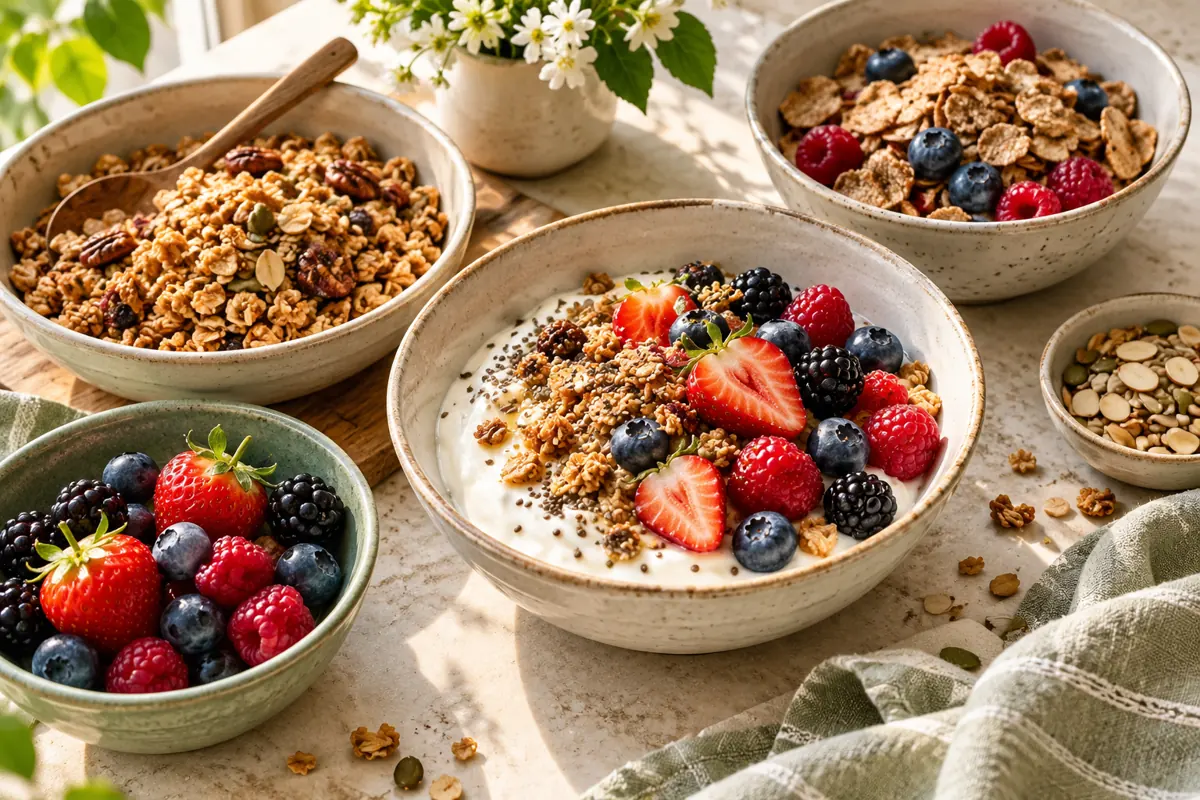
Words such as “natural,” “high protein” or “made with whole grains” can describe one feature of a food without telling you everything about it. A food can contain useful nutrients and still be higher in sugar or salt than you expected. The easiest way to find out is to turn the packet around.
Five places to look
- Granola and breakfast cereal: recipes vary. Compare sugar per 100 g, then consider your usual serving. Mix a favourite granola with plain oats if you want its flavour with less sweetness overall.
- Flavoured yogurt: compare a flavoured product with plain yogurt and fruit. Some plain dairy yogurt contains naturally occurring milk sugar, so total sugar is not identical to added sugar.
- Soups and broths: convenient options can differ substantially in salt. Compare the same type of product; add beans or vegetables if you like.
- Stir-in sauces and dressings: sweet chilli and some other sauces may contain added sugar; soy-based sauces can be high in salt. Check both, because reducing one does not necessarily reduce the other. NHS: cutting down on sugar.
- Packaged snacks and bars: a protein or fibre claim is not a substitute for reading the nutrition panel. Compare a few options and choose the tradeoff you prefer.
Compare like with like
Use the figures per 100 g or 100 ml to compare products, then use the portion information—or your usual portion—to understand what you eat. For example, a cereal with 20 g sugar per 100 g provides about 8 g in a 40 g serving; a cereal with 10 g per 100 g provides about 4 g in the same serving. These are illustrative numbers, not specific products. NHS label guide.
Total sugar is not the whole story
Labels vary by country. Total sugar includes naturally occurring sugars as well as added sugars; in some jurisdictions added sugars are listed separately. WHO’s category of free sugars includes added sugars and sugars in honey, syrups and fruit juice. A plain yogurt and a sweetened drink with the same total sugar are not necessarily equivalent foods. Source: WHO.
Keep the food, adjust the pattern
Try a smaller amount of a favourite sauce alongside lemon and herbs, choose a lower-salt soup, or blend sweetened cereal with plain oats. None of these foods needs to be labelled “bad.” A label is a tool for choosing—not a verdict on what you are allowed to eat.
Why the front of the packet is only a starting point
Food labels often emphasise one feature: a cereal may contain whole grains, a bar may be high in protein, and a sauce may be described as natural. Those statements do not necessarily describe the entire product. A food can contain useful fibre or protein and still have more sugar, salt or saturated fat than another option. The question is not whether the front is “lying,” but which information you need for your own choice.
Turn the packet over and look at the nutrition panel and ingredients. Compare similar foods using a common amount, then consider the portion you normally eat. The NHS label guide explains how to compare values per 100 g or 100 ml. Labels vary by country, so use the format on your own product.
Breakfast: granola, cereal and yogurt
Granola recipes range from mostly oats and nuts to mixtures with sweeteners, chocolate or dried fruit. A cereal with 20 g total sugar per 100 g has about 8 g in a 40 g portion; if you pour 60 g, the same calculation gives 12 g. That example is arithmetic, not a claim about a brand. Compare it with a similar cereal at the same weight, then decide whether you prefer the taste, convenience or nutrition tradeoff.
Yogurt requires another distinction. Plain dairy yogurt naturally contains milk sugar, while a flavoured yogurt may also contain sweeteners or fruit. Total sugars on a label include naturally occurring as well as added sugars. Where added sugar is listed separately, it is included within the total rather than added to it a second time. CDC: Added and total sugars.
Keep the choice practical: add fruit to plain yogurt, blend favourite granola with plain oats, or serve a smaller amount of the sweet cereal alongside a less-sweet one. These changes preserve the flavour you like without requiring an all-or-nothing decision.
Savoury foods can surprise you too
Soup, stock, sauces, dressings and prepared meals may vary substantially in salt. Compare two similar products: a soup with less sodium per 100 g may still contribute a meaningful amount if the entire serving is large. Conversely, a strongly flavoured condiment used in a small quantity plays a different role from a sauce poured generously over a meal.
Sodium and salt are related but not identical. One gram of salt contains about 0.4 g sodium, so 400 mg sodium corresponds to approximately 1 g salt. If a product lists sodium in milligrams, convert to grams before making a comparison. WHO: sodium and salt.
Try lower-sodium stock, add lemon and herbs to a soup, or dilute a strong sauce with yogurt or an unsalted tomato base. A reduced-sodium product can still contain salt; use the number on the label and your usual portion to decide what is useful to you.
Five claims worth reading in context
- “High protein”: can be helpful information, but compare the sugar, salt and saturated fat too. A claim about one nutrient does not describe the complete food.
- “Made with whole grains”: check the ingredients and fibre information to understand the actual product. A small amount of whole grain does not make all similar products equivalent.
- “Natural”: describes neither the amount of sugar or salt nor whether the food suits your needs. Use the nutrition panel for those details.
- “No added sugar”: does not necessarily mean no sugar. Milk and fruit can contain naturally occurring sugars; products and labelling rules vary.
- “Reduced salt”: is a comparison with another product or version. Check the remaining amount and the serving size.
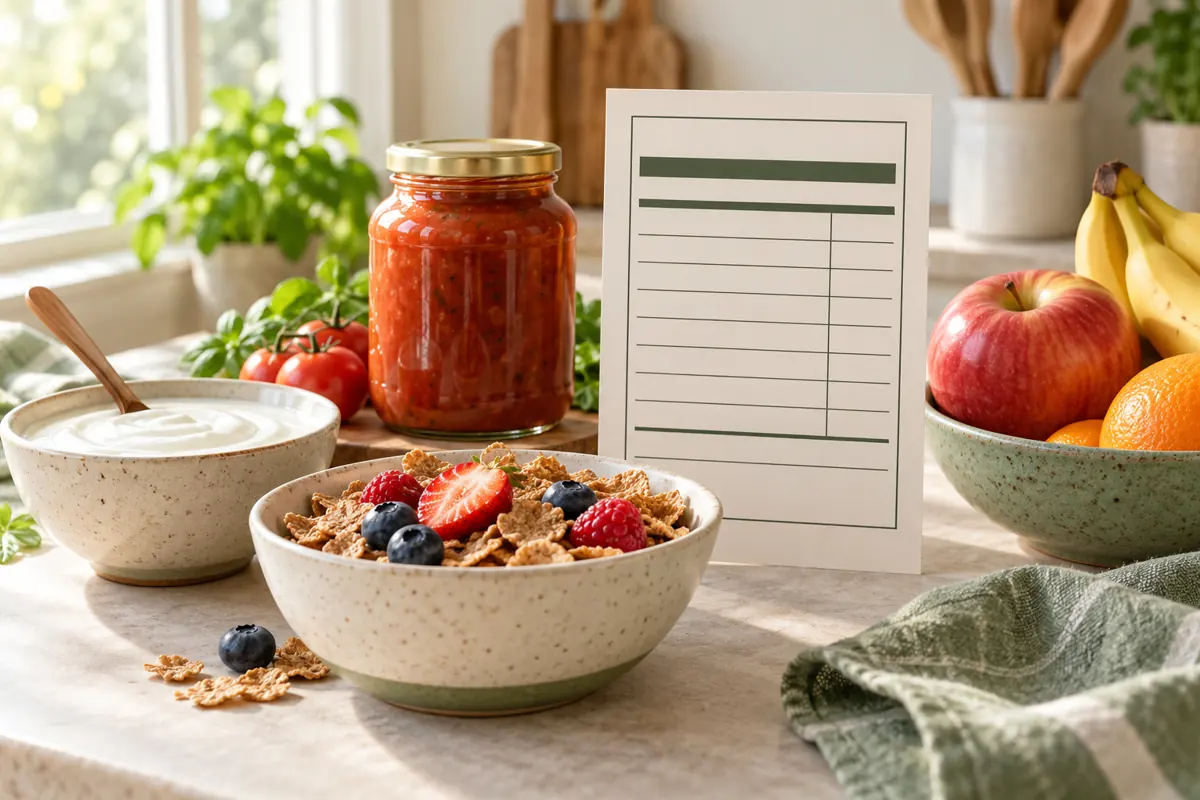
What about fruit, honey and juice?
WHO’s definition of free sugars includes sugars added by manufacturers or cooks and sugars naturally present in honey, syrups, fruit juice and fruit juice concentrates. Whole fruit is a different food with a different structure and nutrient context. Total sugar alone does not tell you everything about either product. WHO: healthy diet.
That distinction does not mean a spoonful of honey ruins breakfast or that you need to avoid a favourite sauce. It means that a “natural” sweetener can still contribute free sugars. Decide which changes are worthwhile over time and keep meals enjoyable.
A two-minute label exercise
- Pick two comparable products you would actually eat.
- Compare per 100 g or per 100 ml where available; otherwise make their serving sizes comparable.
- Check the nutrients relevant to your choice: perhaps sodium, sugar, saturated fat, protein or fibre.
- Estimate your usual amount and multiply accordingly. A 30 g serving is 0.3 times a per-100 g figure.
- Balance the numbers with price, allergies, taste and convenience. There may not be one universally best answer.
Caloza can help you view an estimated meal breakdown, but a photo does not reliably reveal the exact sugar or salt in a packaged product. Use the label for product-specific information and add a note when a sauce or ingredient is not visible. Treat the app’s output as an editable estimate, not a medical assessment.
Worked example: a breakfast comparison
Imagine cereal A contains 16 g total sugar per 100 g and cereal B contains 8 g per 100 g. At the same 50 g portion, those amounts become 8 g and 4 g respectively. If your usual portions differ, calculate each using its own amount; a comparison that ignores serving size can mislead. Also compare fibre, ingredients and taste. These invented figures illustrate the method and do not describe a particular cereal.
Now imagine pairing either cereal with plain yogurt and fruit. The yogurt and fruit can contribute naturally occurring sugars, and the full meal has a different nutritional context from the cereal alone. The goal is to understand what you are comparing, not to treat a single number as a moral score.
Worked example: soup and stock
A soup might list 0.6 g salt per 100 g. A 300 g bowl would contain about 1.8 g salt from the soup if the label values and portion apply. A different soup may list less per 100 g, but check whether its suggested portion is the same. If you add cheese, stock or a salty condiment, those ingredients contribute their own amounts. These are examples; real product recipes vary.
Try a lower-salt stock and add garlic, herbs or lemon for flavour. If you enjoy a regular soup, you can add beans or vegetables and adjust any extra salt to taste. Read labels with the NHS guide if you are unsure which units apply.
A decision that accounts for real life
There may be no perfect product on the shelf, and not everyone needs to optimise the same nutrient. If affordability, an allergy or time is your main concern, a different choice may be sensible. Make a comparison when it helps, keep foods you like, and make a manageable change where it matters to you. A pattern over time tells you more than the front of one package.
Remember that formulations change
Product recipes and label formats can change, so use the packet you have rather than relying on a remembered number or a photo of an older label. Compare the same units and check whether the serving is the amount you actually eat. If you are choosing for a medical condition, your clinician or dietitian can explain which label details are most relevant for you. General examples are useful for learning the calculation but do not replace individual advice.
Keep a comparison you can repeat
When you find two products you like, compare them using the same units and write down the one detail that matters for your household. For example, you might look at sodium in soup, added sugar where listed on a breakfast cereal, or saturated fat in a dressing. Next time you shop, recheck the current packaging because formulations and portion sizes can change. The NHS guide to reading labels explains how to compare products on a common basis.
It is fine to keep your favourite and make a change elsewhere, or to prioritise price, accessibility and taste. The purpose of comparison is to make information useful for a decision you choose to make.