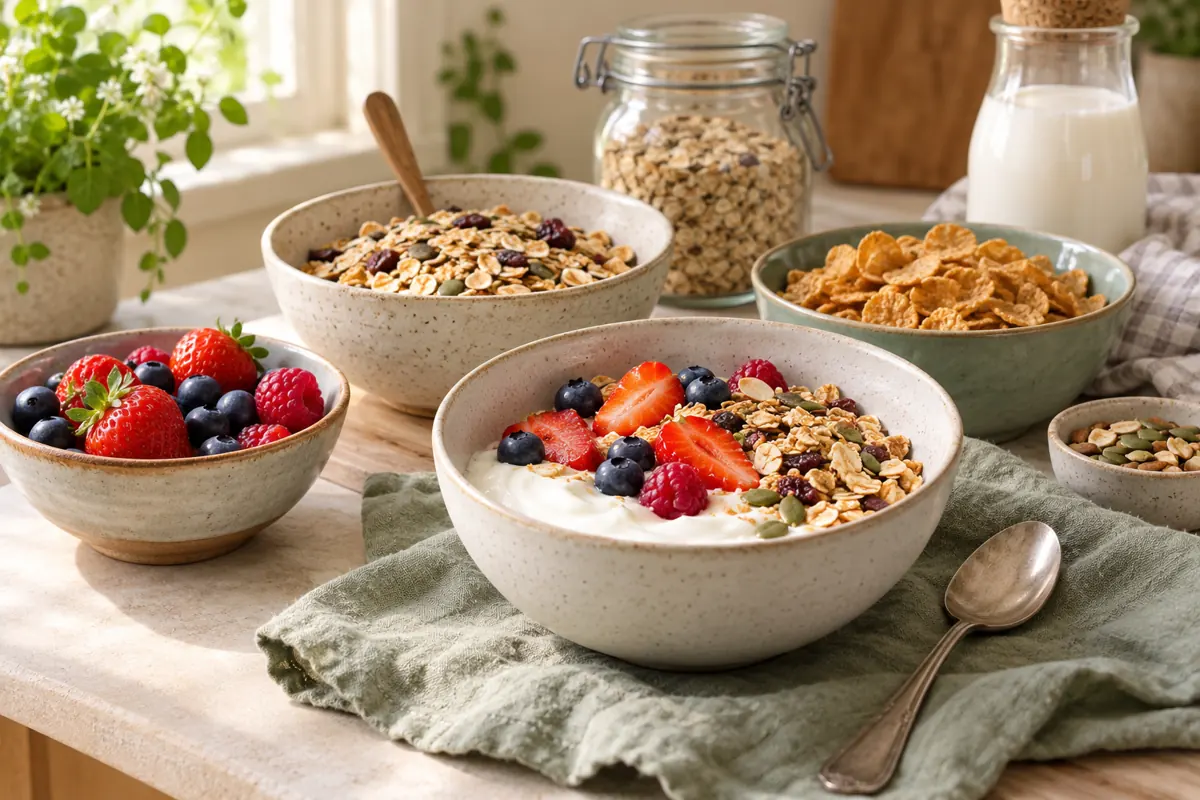
A packet can say “natural”, “protein” or “whole grain” and still leave an important question unanswered: what is in the portion you actually eat? Granola, yogurt and cereal can all fit into a balanced breakfast. Comparing a few label details is more helpful than judging them by the front of the box.
Start with the serving size
In the United States, the MedlinePlus food-label guide explains that a label serving reflects an amount people typically consume; it is not a recommendation. If a cereal label gives values for 40 grams and you pour 60 grams, multiply its listed nutrients by 1.5. Other countries often show figures per 100 grams, which can make comparisons easier.
As a made-up example, a granola has 8 grams of sugar per 40-gram serving. A 60-gram bowl has 12 grams of sugar from the granola, before milk or other toppings. The calculation is not a judgment about whether you should eat it; it simply makes the label useful.
Read sugar in context
Plain dairy yogurt naturally contains milk sugar. Fruit also contains natural sugars. On US labels, added sugars are listed within total sugars; do not add the two figures together. Other countries use different labels, and total sugar alone does not always show how much was added.
Compare similar products and choose a level of sweetness you enjoy. If a sweetened yogurt is your favorite, you could mix it with plain yogurt or add fruit for flavor. There is no need to assume all sugar in every yogurt was added.
What else is useful to compare?
- Fibre: compare cereals and granolas at the same weight. Oats and whole grains can contribute fibre; amounts vary substantially between products.
- Protein: yogurt types differ. Check the package, including plant-based alternatives, instead of assuming they contain the same amount.
- Saturated fat and sodium: check these when comparing products that you eat often. Granola recipes and toppings vary.
- Ingredients: look for foods you enjoy and check allergens. A short list by itself does not tell you every nutritional detail.
Build a breakfast you look forward to
Try plain or lightly sweetened yogurt with fruit, a spoonful of crunchy granola and nuts. Or make cereal more filling for your tastes with milk or a fortified alternative and fruit. Want the granola to be the star? Enjoy a bowl and use the label to understand the portion rather than treating a number as a verdict.
If you log a bowl with Caloza, review its detected ingredients and serving estimates. A photograph cannot reliably identify the exact brand or reveal all added sugar; the package label is the better source for those details.
What the front of a package can and cannot tell you
Terms such as “natural,” “made with whole grain” or “high protein” are designed to highlight particular features. They are not a complete nutritional profile. A cereal can contain some whole grain and still differ greatly from another cereal in fibre, sugar or serving size. A yogurt advertised as high protein may be useful for that reason while still tasting sweeter than another variety. The right question is which features matter to you and what the back label actually says.
Definitions and permitted claims vary by country. Use the local label rather than interpreting a package from another market as if it followed the same rules. When you have dietary restrictions or allergies, check the full ingredient and allergen information every time; recipes can change.
Compare like with like: a worked example
Imagine cereal A lists 6 grams of fibre per 100 grams and cereal B lists 4 grams per 100 grams. At the same weight, A provides more fibre. Now imagine the only label available gives A's figures for 30 grams and B's for 60 grams. You cannot compare the two numbers directly without adjusting the portions. Multiply a per-serving figure by the amount you intend to eat divided by the stated serving amount.
For example, if a cereal lists 3 grams of fibre per 40 grams and you serve 60 grams, the arithmetic is 3 × 60 ÷ 40, or 4.5 grams. This is an illustration, not a claim about a particular product. The MedlinePlus food-label guide explains that US nutrition values relate to the stated serving. Milk, yogurt, fruit and nuts added to the bowl contribute their own nutrients, so a cereal label is not the whole meal.
What makes granola different from cereal?
Granola is often a mixture of oats or other grains, nuts, seeds, sweeteners and oil, baked for crunch. Recipes vary widely. A small amount can be a flavorful topping, while a larger bowl can be the main component of breakfast. Both are legitimate choices; look at the actual serving you enjoy and what else goes into the bowl.
To choose between products, compare fibre and protein as well as sugars and saturated fat on the same-weight basis when available. If you love a sweet, crunchy variety, try mixing it with plain oats or a less sweet cereal to extend the flavor. If you prefer the original, use it as it is. A label helps you understand the choice; it does not have to become a test of willpower.
Yogurt: dairy, strained and plant-based
Plain dairy yogurt contains naturally occurring milk sugar. Strained varieties may have a different texture and nutrient profile from regular yogurt; check the specific product instead of relying on the word “Greek” to predict a number. Flavored varieties may contain added sugar. Compare plain and flavored versions for sweetness, protein, fat and any other feature that matters to you.
Plant-based alternatives can use soy, oat, coconut or other ingredients. Their protein and fortification vary. If you use one as a regular substitute for dairy yogurt, check its protein and added calcium or other fortification on the label where listed. A coconut-based product should not be assumed to have the same profile as one made from soy. Choose an option that fits your tastes, dietary needs and budget.
For a less sweet bowl, mix plain yogurt with fruit and cinnamon, or combine plain and flavored yogurt in a proportion you enjoy. If you need a dairy-free or nut-free meal, check the ingredients and allergen statement for every component, including granola.
Whole grains and fibre: how to choose
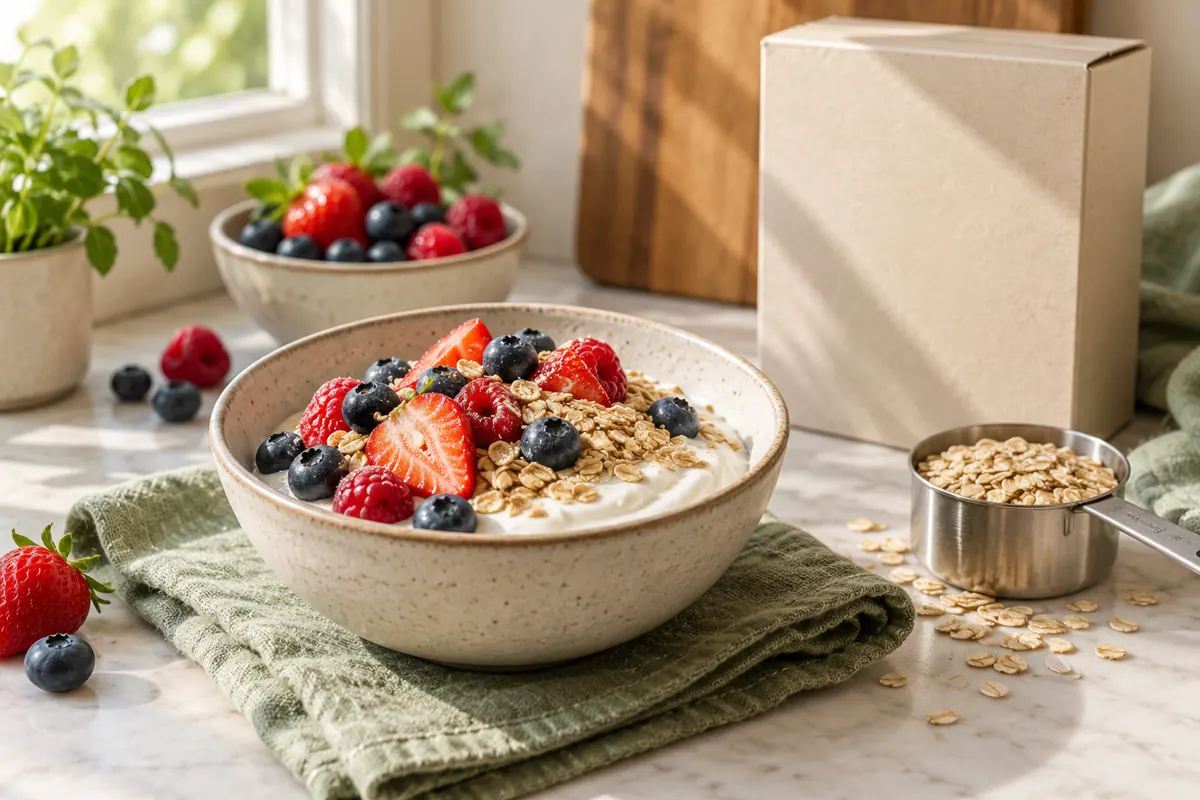
Oats and whole-grain cereals can contribute fibre, but products differ in their actual amounts. Compare the fibre values for the portion you expect to eat and look at the ingredient list for foods you recognize. The WHO recommends that carbohydrate sources include whole grains, vegetables, fruit and pulses. This does not mean every breakfast cereal needs to meet a single universal fibre target.
A practical bowl might combine a cereal you like with plain yogurt, berries and a few nuts if those are safe for you. Another might use warm oats with milk and banana. If you prefer toast or a savory breakfast, there is no need to force yourself to eat cereal; variety over time matters more than a perfect bowl.
Three breakfast templates for different mornings
- Five-minute bowl: plain yogurt, fresh or thawed fruit prepared according to its label, and a spoonful of granola. Add more cereal if that makes the meal satisfying for you.
- Warm and comforting: cook oats with milk or an alternative, then add sliced fruit and cinnamon. For crunch, finish with nuts or seeds if suitable for you.
- Take-along breakfast: pack cereal and yogurt separately to retain texture, add a piece of fruit, and keep perishable ingredients cool as directed. An insulated bag with an ice pack can help when refrigeration is unavailable.
Choose portions for your appetite and circumstances; the examples are combinations, not calorie prescriptions. If you find yourself hungry soon afterward, experiment with adding a protein source, more food, or a different texture. If a breakfast leaves you uncomfortably full, adjust the amount or composition.
How added sugar differs from total sugar
On US labels, “includes added sugars” appears within total sugars. It describes a subset, so adding the two values together would count some sugar twice. The CDC guide to added sugars describes the distinction. Labels in other countries may display total sugars without a separate added-sugar line; the ingredient list can provide context, though it does not always tell you the exact amount added.
It is useful to recognize a difference between plain yogurt with milk sugar and a dessert-style yogurt sweetened during production. It is also useful to avoid assuming that the second can never be enjoyed. Compare brands, consider frequency and portion, and select what fits your wider eating pattern.
What can Caloza see?
A photo can show visible cereal, yogurt, fruit and toppings, but it cannot read a hidden label or determine the exact formulation reliably. Review the detected ingredients and portions, and add a note when useful. For brand-specific sugar or protein, the package is the stronger reference; Caloza's result is an editable estimate and may need correction. It should not be used to decide whether a food is safe for someone with an allergy.
Four common label traps
Comparing a serving to 100 grams: these numbers have different denominators. Convert one to the other's basis before deciding which product has more or less of a nutrient.
Counting only the cereal: milk, plant drinks, yogurt, fruit and toppings contribute their own nutrients. If you want to understand the whole breakfast, look at the complete bowl rather than a single packet.
Assuming brown color means whole grain: color and marketing can be clues but do not replace the ingredient list. Look for the grain named on the package and compare fibre values on an equal-weight basis.
Assuming a “protein” claim tells you the whole story: protein can be useful, but serving size, sweetness, saturated fat and price may matter as well. Compare products that you would actually eat.
Make a comparison that suits your goal
If you want more fibre, compare cereal packages per 100 grams and choose a texture you enjoy. If protein matters, compare yogurts using the same portion and consider whether the alternative you like is fortified. If sweetness is your concern, compare added sugar where listed; remember that local labels differ. If money is tight, include price per useful portion and how much will be wasted.
Then put the label away and eat. A package is a tool for understanding a product, not a demand to optimize every breakfast. If dietary calculations are distressing, choose a breakfast you enjoy and seek support from a qualified professional rather than forcing yourself to log it.
Safe storage matters too
Store perishable yogurt according to the package and keep it chilled. Reseal cereal and granola to preserve texture and follow the label's storage guidance. If you prepare breakfast ahead, use a clean covered container, refrigerate promptly and account for any toppings with their own storage needs. Food safety is part of a useful breakfast routine, not something the nutrition label alone can tell you.
A simple way to try a new breakfast
Choose one bowl you already enjoy as your starting point. Next time, change one element: add a spoonful of oats, try a different yogurt, or put fruit on the side. Notice the flavor, texture, convenience and how satisfying the meal feels to you. Keep the change if it works; if it does not, try another combination. This is a personal experiment in preference, not a clinical test or a promise of a particular health outcome.
If you buy breakfast for several people, compare the total price and serving sizes as well as nutrition. A larger package only saves money if you can store and use it before its quality declines.