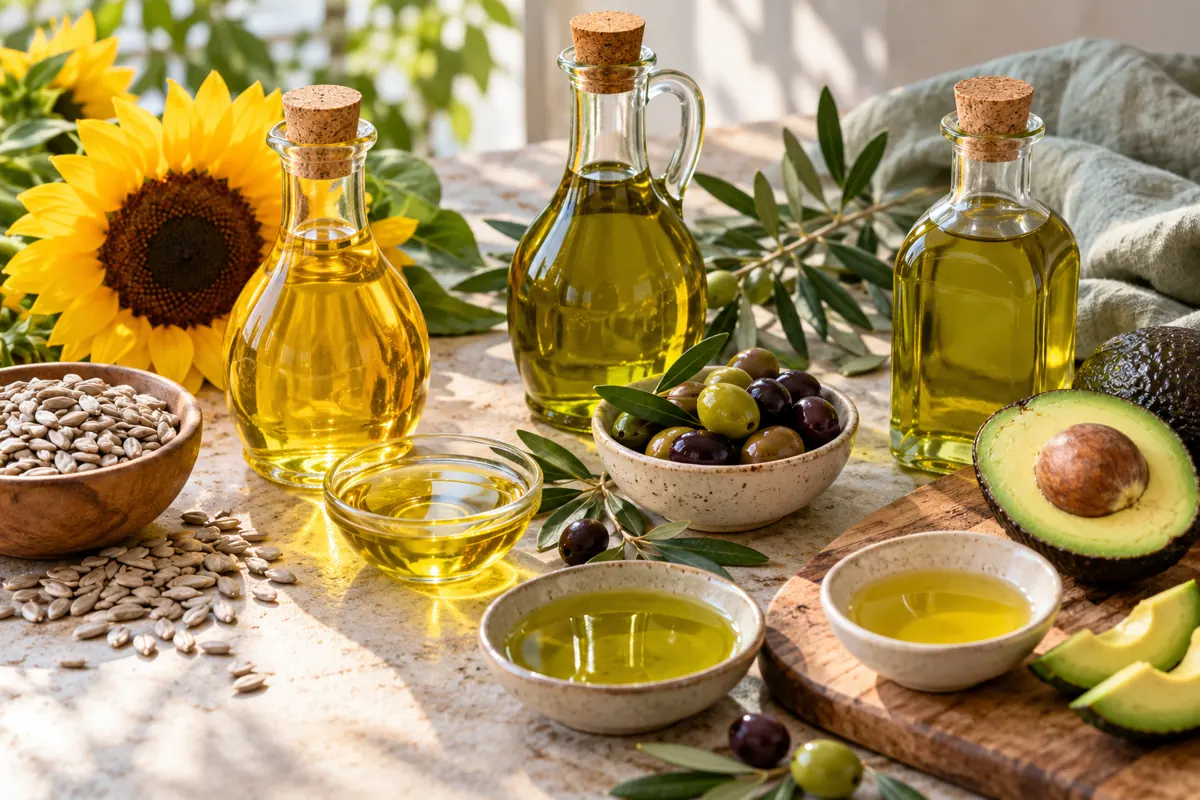
Sunflower, canola, soybean and corn oils have become the subject of alarming claims online. The short answer: current evidence does not show that ordinary culinary use of these oils is harmful. They are rich in unsaturated fats, and replacing saturated fat with polyunsaturated fat is generally supported by cardiovascular evidence. That does not make every food made with seed oil nutritious, or mean that more oil is always better.
What counts as a seed oil?
Seed oils are extracted from seeds such as sunflower, rapeseed (canola), soybean, sesame and corn. They differ in flavour and fatty-acid composition. Olive and avocado oils are made from fruit, though they too contain predominantly unsaturated fats. The World Health Organization recommends shifting intake away from saturated fat toward unsaturated fats, including oils such as sunflower and soybean. WHO: healthy diet.
What does the research actually show?
A systematic review of prospective studies and randomized trials found modest support for replacing saturated fats with polyunsaturated fats to reduce coronary events. This is about what one fat replaces in the diet, not proof that adding oil to any meal improves health. Long-term nutrition studies have limitations: dietary patterns are difficult to isolate and people do not eat a single ingredient in isolation.
Omega-6 linoleic acid, found in many seed oils, is an essential fatty acid. The presence of omega-6 does not by itself establish that an oil causes harmful inflammation. The American Heart Association’s discussion explains the distinction and corrects an earlier claim about omega-6 and inflammation.
Why do seed oils appear in foods people worry about?
An oil can be used in a stir-fry full of vegetables or in a packaged snack. Those are different foods with different amounts of salt, saturated fat and other ingredients. Blaming one ingredient does not tell you whether the whole meal is balanced. Similarly, butter, coconut oil and palm oil contain more saturated fat than many liquid plant oils; that difference is more informative than whether an oil is labelled “natural.”
How to use them in your kitchen
- Choose for flavour and use: neutral canola for everyday cooking, olive oil for a dressing, or toasted sesame oil for a finishing flavour.
- Heat gently enough that oil does not smoke; discard oil that smells rancid. The American Heart Association advises against reusing cooking oil.
- Use enough to make a meal enjoyable. Oil is energy-dense, so if you want to understand the energy in a meal, measure a usual pour once and learn what it looks like.
There is no need to throw out your sunflower oil or stop enjoying olive oil. Look at your overall eating pattern, not a single ingredient. If you have a food allergy or a condition requiring a particular diet, follow individual medical advice.
Why the comparison matters more than a single ingredient
When a headline says a fat is “healthy” or “unhealthy,” ask what it is being compared with. Replacing butter in a vegetable stir-fry with a liquid oil is a different change from adding extra oil to a meal that already contains it. In the first case, one source of fat replaces another; in the second, the total amount changes. The fatty-acid review discussed above assessed several types of evidence and found modest support for replacing saturated fat with polyunsaturated fat. It did not test every commercial bottle, meal or cooking practice.
Think of a simple dinner: beans, vegetables and rice. You might cook the onion in canola oil, finish the bowl with olive oil, or use a small amount of butter for flavour. The choice changes the flavour and the types of fat; it does not by itself determine the value of the rest of the dinner. Compare the whole meal and your broader eating pattern rather than treating any single ingredient as a shortcut to health.
What are omega-6 and omega-3 fats?
Both names refer to families of polyunsaturated fatty acids. Linoleic acid, an omega-6 fat found in many seed oils, and alpha-linolenic acid, an omega-3 fat found in some plant foods, are essential: the body needs them and cannot make them itself. This does not mean that taking either in unlimited quantities is useful. It means that their presence in food should not be treated as proof of harm. The WHO healthy-diet guidance explains the role of dietary fats and the distinction between types.
Online claims sometimes move from the true statement that inflammation plays a role in normal immune responses to a much larger claim that consuming any omega-6 fat causes chronic inflammation. That conclusion is not established by the ingredient’s name. The American Heart Association discussion of seed oils addresses this distinction and notes that earlier wording about omega-6 and inflammation was corrected. If a post makes a strong claim, look for a human study of dietary intake or health outcomes, not only a biochemical explanation.
Does processing automatically make an oil unsafe?
Cooking oils can be pressed, refined or otherwise processed. Refining can affect taste, colour and suitability for a particular use. Processing alone does not tell you the nutritional quality or safety of a finished food. Equally, “cold-pressed” or “natural” does not tell you how a bottle was stored or whether its flavour has deteriorated. For a helpful comparison, examine the product’s fat profile, ingredients, intended use and storage instructions.
A transparent comparison also separates evidence about an oil from evidence about a whole packaged food. A crisp or pastry can contain a seed oil as well as salt, sugar or other fats. You cannot determine which component explains a health outcome simply because the ingredients appear together. That does not make label reading pointless; it makes the complete label more useful than a single highlighted ingredient.
Five practical questions at the supermarket
- What will I cook? A neutral oil works in a variety of dishes; a stronger olive or toasted sesame flavour may be exactly what a dressing or finishing drizzle needs.
- How much will I use before the bottle ages? A size that fits your cooking routine can be more useful than a large bottle you rarely open. Store as the label directs and away from heat and light.
- What kind of fat does it contain? Use the nutrition panel to compare saturated fat per the same volume or weight. Oils differ by seed and formulation.
- Does the flavour suit the meal? If a mild oil helps you enjoy a vegetable stir-fry, that is a practical advantage. Price and availability are legitimate considerations too.
- Is there an allergy concern? Follow specific clinical advice and product labelling. Do not assume that all oils are interchangeable for somebody with a food allergy.
Cooking, smoke and storage
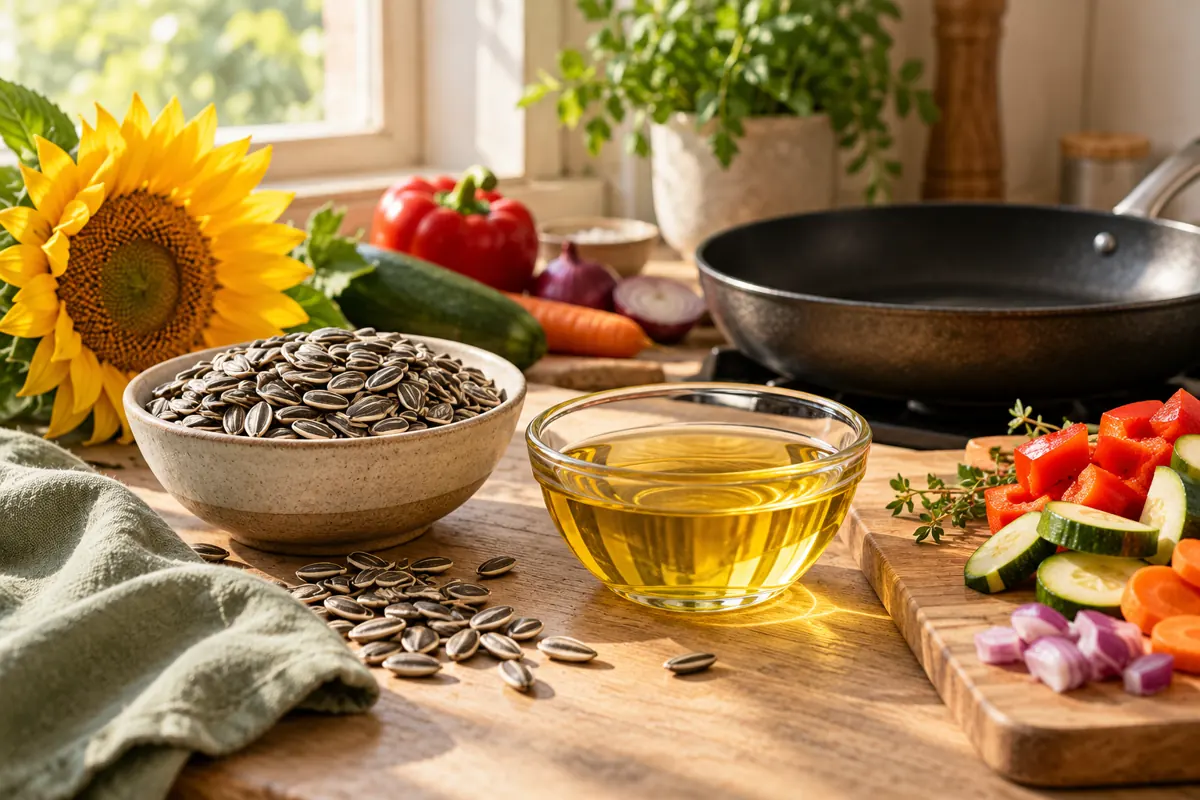
Use a pan appropriate for your method, add the oil as your recipe directs and keep an eye on the heat. If the oil starts smoking, turn off the heat, ventilate the area and allow it to cool safely before discarding it; do not keep cooking in it. Repeatedly heating oil is a different situation from a normal home sauté. The AHA cooking-oil guide recommends not reusing cooking oil and discarding oil that smells rancid.
There is no need to select a bottle solely because it has the highest advertised smoke point. Cooking temperature, duration, refinement, flavour and price all matter. For dressings and lower-temperature cooking, choose an oil you enjoy. For roasting or pan cooking, follow the specific oil’s guidance and avoid visible smoke. Never pour water on an oil fire.
What can a meal photo tell you about oil?
A photo may show a glossy dressing or oil in a pan, but it cannot reliably reveal how much was absorbed or mixed into a finished dish. If you are curious, measure a typical pour once, then note the amount used for the whole recipe and how many servings it made. A tablespoon added to a four-serving pan is not automatically a tablespoon in every serving. The estimate remains approximate because some may remain in the pan or dressing bowl.
Caloza can start from a meal photo and lets you review detected items and portion assumptions. Add a note if you know the cooking oil or sauce used, and review the result instead of treating it as a laboratory measurement. You can use that information to understand your routine without turning each drizzle into a test you must pass.
Quick answers
Should I throw away my sunflower or canola oil? The evidence cited here does not support a blanket instruction to avoid ordinary use. If the bottle is rancid or improperly stored, replace it for quality and safety.
Is olive oil the only worthwhile choice? No. Olive oil is one useful unsaturated-fat option, and other liquid plant oils can fit as well. Choose for the food, your budget and individual needs.
Does a food containing seed oil become nutritious automatically? No. Look at the whole food, the portion and how it fits your meals. A neutral cooking oil and a heavily salted snack made with that oil are not the same comparison.
How to evaluate the next alarming claim you see
Start by asking what was studied. A trial in people comparing two diets tells you something different from an experiment on cells or a chemical measurement in oil heated under laboratory conditions. Laboratory studies can suggest questions for research, but they do not by themselves show what happens when someone uses a normal amount of oil at home. Look for the dose, the cooking conditions, the comparison food and the health outcome.
Next, ask whether the researchers measured a disease outcome, a blood marker, or simply the presence of a compound. Each can be relevant, but they answer different questions. A marker changing is not automatically the same as a person developing a disease. Reviews that combine multiple studies can help put findings in context, although their conclusions depend on the quality and consistency of the included studies.
Finally, distinguish confidence from certainty. The linked systematic review reports modest support for replacing saturated with polyunsaturated fats, not evidence that every product or every possible intake is beneficial. Nutrition studies face real difficulties: people eat mixed diets, food intake can be hard to measure, and interventions differ. The strongest practical conclusion is therefore measured: choose an oil that fits the meal, cook and store it appropriately, and consider what it replaces.
A week of ordinary uses
On Monday, cook peppers and onions in a small amount of canola oil for a bean bowl. On Tuesday, use olive oil, vinegar and herbs for a salad. Later, roast potatoes and vegetables with a liquid plant oil and finish with lemon. For noodles, add toasted sesame oil at the end if its flavour appeals. These examples show options rather than a required rotation: one affordable oil may serve most of your meals.
If a recipe makes several servings, write down the amount used for the entire pan and divide it by the approximate number of portions as a starting point. The actual portion remains uncertain if serving sizes differ or oil is left behind. A meal tracker can help you remember the ingredient, but it cannot determine the exact oil content from a photograph alone.
What to remember when planning a meal
For practical cooking, start with the dish rather than an online ranking of oils. A liquid plant oil you enjoy can help make vegetables, beans or whole grains satisfying. Select an amount that suits the recipe, take care with heat, and replace oil that has become rancid. If you want to compare oils, look at fat composition per the same amount and consider which fat the oil replaces in your usual cooking.
For the broader question of health, no bottle tells the whole story. Your overall pattern, food preferences, access and medical needs all matter. A personalised dietary question is best discussed with a qualified professional who knows your circumstances.